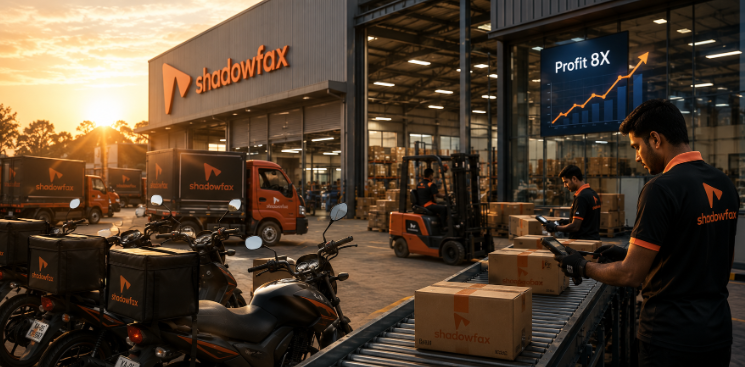
The last-mile and hyperlocal logistics firm reported revenue from operations of Rs 1,358 crore for the quarter ended June 2026, up 65% from Rs 824 crore in the same period last year, according to financial statements sourced from the National Stock Exchange. Profit did even more dramatic work, surging more than eightfold to Rs 65 crore from just Rs 8 crore a year earlier. Add Rs 21 crore of other income, and total income for the quarter reached Rs 1,379 crore, up 10% from Rs 1,253 crore in the previous quarter.
What makes this quarter stand out is not just the growth, but the discipline behind it. Shadowfax's total expenditure rose 60% year-on-year to Rs 1,314 crore, a big jump on its own, but still slower than the 65% revenue climb. That small gap between the two growth rates is exactly what let profit multiply the way it did. Employee benefit expenses rose 49% to Rs 124 crore as the company scaled its workforce, while depreciation and amortisation costs jumped 82% to Rs 40 crore, likely reflecting continued investment in delivery infrastructure and technology.
Shadowfax operates in a genuinely crowded corner of Indian logistics, competing directly with Delhivery, XpressBees, Ecom Express, and Flipkart's Ekart for business from ecommerce marketplaces, D2C brands, and quick commerce platforms, all of whom need the same thing: reliable delivery at increasingly tight timelines.
Investors responded warmly to the results. Shadowfax shares were trading up 8% at around Rs 237 shortly after the numbers came out, pushing the company's market capitalisation to roughly Rs 13,848 crore, or about $1.45 billion, a reminder that in India's delivery wars, actually making money still counts for something.
Filed by
Startup Unplugged