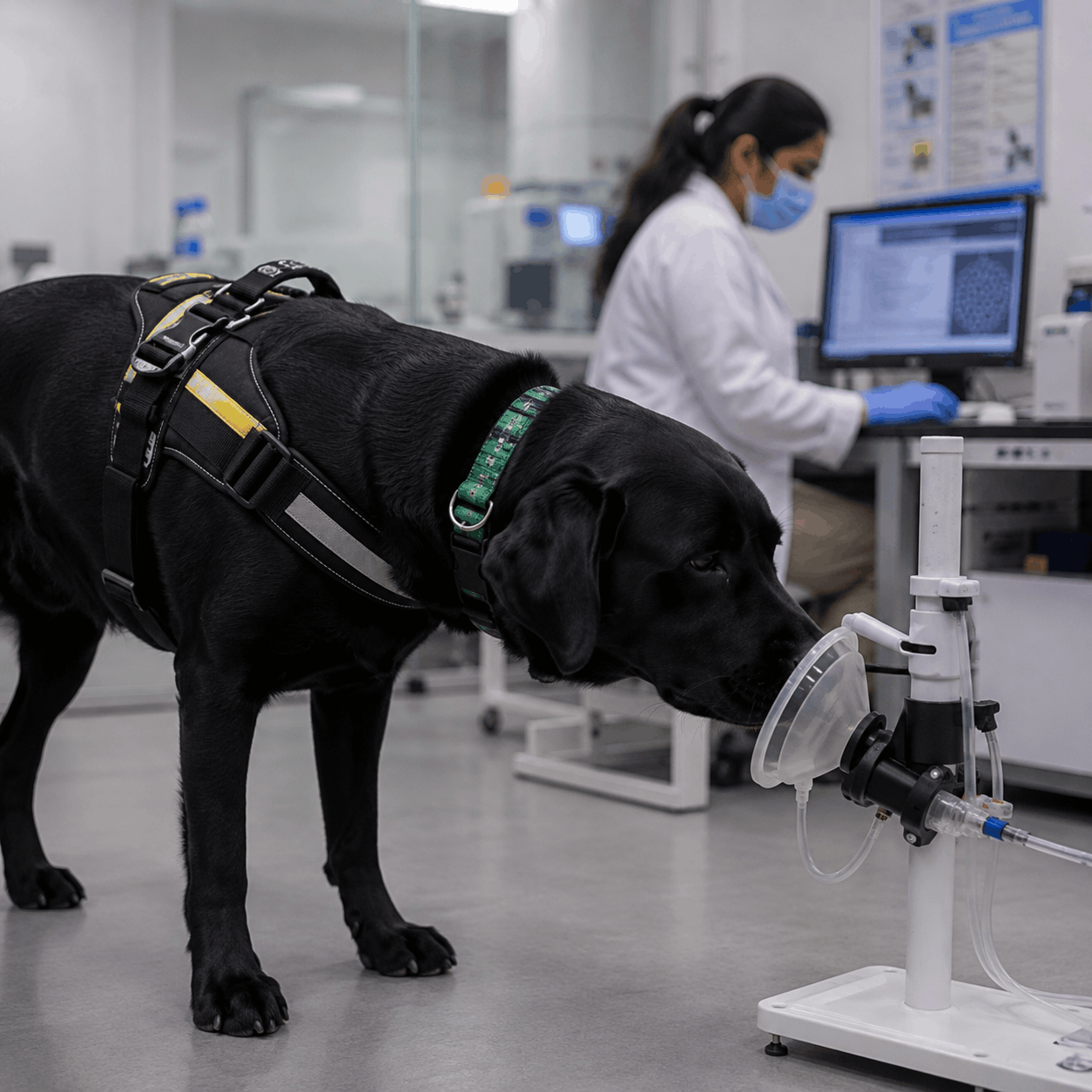
An Indian startup is combining trained dogs, breath samples and artificial intelligence to develop a non-invasive screening system that could help identify people at higher risk of multiple cancers.
Bengaluru-based Dognosis is developing BreathEasy, a platform that collects a person's breath in a face mask and analyses the sample using trained detection dogs and a statistical model. The company says the approach is designed as a prescreening tool, with positive results requiring conventional medical follow-up.
The science behind the system is based on volatile organic compounds, or VOCs, produced by the body. Dogs have highly sensitive senses of smell and can detect patterns in these compounds, while Dognosis uses sensors and machine-learning techniques to turn the dogs' responses into a measurable risk signal.
The technology has now moved beyond a small experimental setting. A Phase II study published in the Journal of Clinical Oncology evaluated 3,275 participants across six hospitals in Karnataka, including 1,502 people in the final testing cohort. The test group included 283 people with biopsy-confirmed cancer and 1,219 controls.
The study reported 90.8 per cent sensitivity and 91.3 per cent specificity, with an area under the receiver operating characteristic curve of 0.962. Sensitivity for Stage I and II disease was 90.6 per cent, according to the published study.
In simple terms, sensitivity measures how well the system identifies people who have cancer, while specificity measures how well it identifies people who do not have cancer. These figures are encouraging, but they do not mean the system can independently diagnose cancer.
That distinction is important because the published research describes the work as demonstrating analytical validity and supporting further evaluation in genuine screening populations. The study's authors said prospective evaluation was still needed.
The testing process is designed to keep the dogs away from direct contact with patients. According to Dognosis, people breathe into a cotton face mask for about 10 minutes. The mask is then sealed and transported to a controlled laboratory, where trained dogs assess the sample.
Dognosis says each sample can be assessed by multiple dogs, with their individual indications combined using a Bayesian model. The system also incorporates information about the dogs' previous performance and participant-level factors to produce a final risk score.
The company's technology is therefore not simply about asking a dog to identify cancer. The broader goal is to digitise canine olfaction by combining trained animals with brain-computer interfaces, sensors and machine learning. Dognosis says this could make the biological sensing capability of dogs more scalable.
The potential use case is particularly significant in India, where access to routine cancer screening remains limited. A low-cost breath-based prescreening test could potentially help identify people who should undergo conventional testing, especially in settings where expensive imaging or specialist services are less accessible.
But scaling the technology will be a much larger challenge than demonstrating accuracy in a controlled clinical study.
The Phase II study was conducted across six hospitals in Karnataka and used a defined testing population. A large population-screening programme would expose the system to much greater variation in people, disease prevalence, environmental conditions and sample logistics. The researchers therefore said the findings support further prospective evaluation rather than immediate replacement of established screening methods.
Dognosis is now conducting larger-scale validation. The company says its BreathEasy application is being evaluated in large trials, while reports have said it is targeting a commercial launch in India in 2027, subject to clinical validation.
The company has also attracted investors. Dognosis says it is backed by Accel India, Caffeinated Capital and other investors, while its Accel Atoms profile describes the company as developing a system that combines canine olfaction with brain-computer interfaces, AI and robotics.
The technology could eventually be useful beyond one type of cancer because the Phase II study evaluated seven broad cancer groups, including head and neck, breast, lung, gastrointestinal, gynaecological and genitourinary cancers.
The biggest question is whether the reported performance can be reproduced when the technology is used across much larger and more diverse screening populations. If it can, dogs could become part of a new kind of diagnostic infrastructure in which biological sensing is combined with AI rather than relying only on conventional laboratory equipment.
For now, Dognosis is developing a screening technology, not replacing biopsy, imaging or specialist diagnosis. The results of its larger prospective studies will determine whether the unusual combination of canine smell and AI can move from an intriguing research result to a practical cancer-screening service.
Filed by
Startup Unplugged