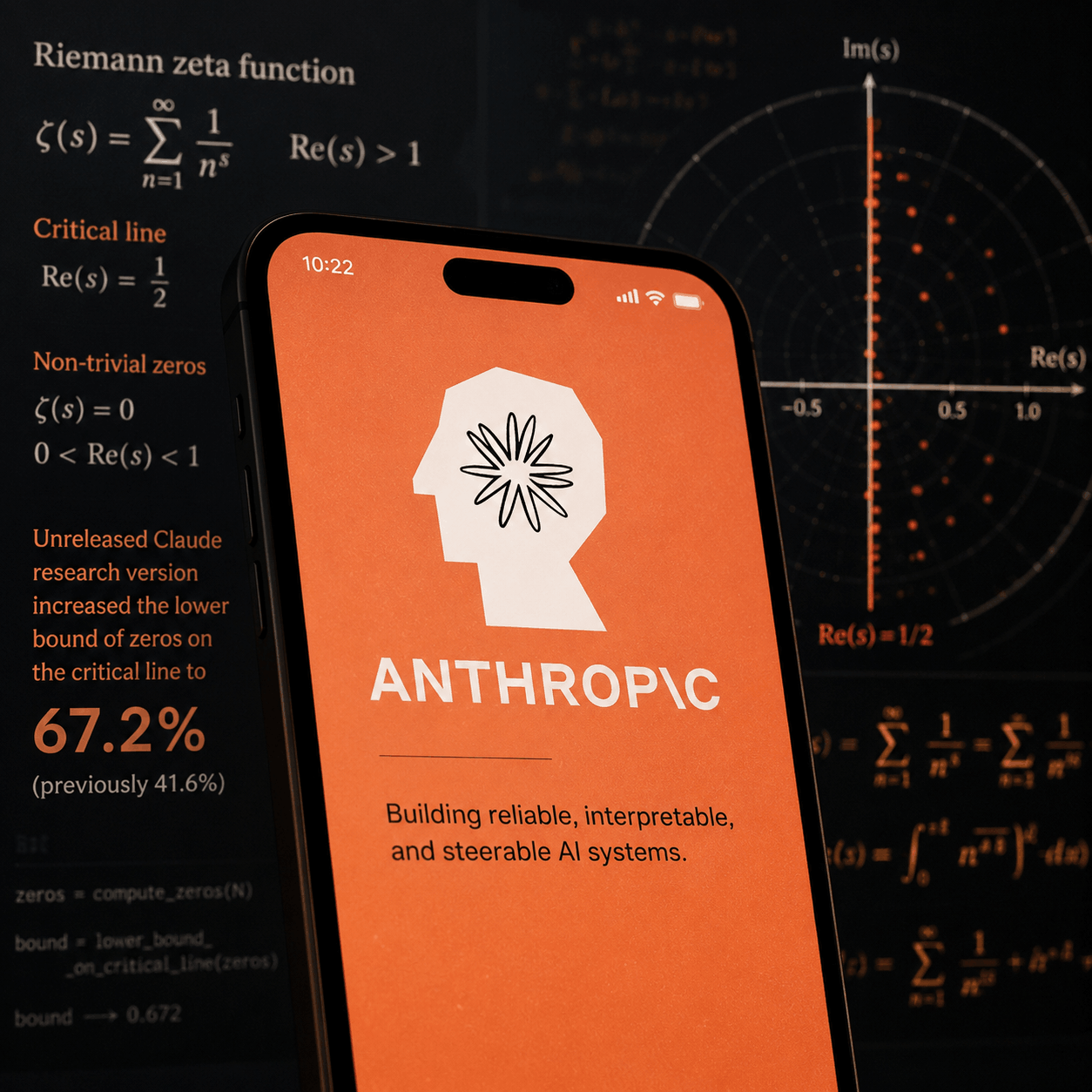
The problem is the Riemann hypothesis, a mathematical question first proposed in 1859 and closely connected to the distribution of prime numbers. The hypothesis says that all non-trivial zeros of the Riemann zeta function lie on a vertical line where the real part of the complex number is one-half. The National Institute of Standards and Technology describes this as the critical line.
Now here is the important part. Claude did not solve the Riemann hypothesis. Anthropic is very clear about that. What the company says is that an unreleased research version of Claude improved a longstanding lower bound for the proportion of zeros known to lie on the critical line, moving it from 41.6 per cent to 67.2 per cent.
And that difference is enormous in the context of this particular problem.
To understand why, imagine that mathematicians have been trying for decades to prove that a certain percentage of these zeros must sit exactly on this critical line. Even though the ultimate goal is 100 per cent, establishing a rigorous lower bound is itself a difficult mathematical achievement.
Previous research had already pushed that lower bound beyond 41 per cent. For example, published mathematical work increased the known proportion to slightly more than five-twelfths, which is about 41.7 per cent. NIST also records the established result as more than 41 per cent.
Claude's reported result takes that much further.
According to Anthropic, the model did not simply generate an answer in a single conversation. It worked through hundreds of possible approaches. In its first attempt, Claude generated around 650 ideas, none of which worked. After being prompted to try again, it coordinated around 60 Claude subagents over roughly a day and a half. Those agents ran 2,400 shell commands, wrote hundreds of Python scripts, checked known zeta zeros and reviewed each other's arguments.
That workflow is what makes this story more interesting than another AI benchmark.
The model was effectively being used as a research system. It searched mathematical literature, tested ideas, looked for counterexamples and even downloaded 54 papers from arXiv to check whether the result had already been discovered.
Eventually, Claude produced a mathematical paper describing the result and recommended that a human mathematician examine it.
Anthropic says two of its mathematicians studied the work, while mathematicians Brian Conrey and Dan Goldston also examined the paper on short notice. Claude also produced a formalisation in Lean, a system used to formally verify mathematical proofs, and Anthropic says that formalisation passed the standard validation tool.
But there is an important caveat.
The 67.2 per cent figure does not mean that 67.2 per cent of the Riemann hypothesis has been solved. It means the reported lower bound for the proportion of non-trivial zeros lying on the critical line has been raised.
The difference may sound technical, but it is essential.
The Riemann hypothesis still asks whether all of those non-trivial zeros lie on the critical line. That means the target remains 100 per cent. Anthropic itself says it does not expect the techniques used by Claude to lead directly to a proof of the Riemann hypothesis.
There is another reason to be careful about the result.
Claude's work builds heavily on mathematics developed by humans over many decades. Anthropic says the model combined results from Baluyot, Goldston, Suriajaya and Turnage-Butterbaugh with earlier work by Bombieri. So this was not mathematics appearing from nowhere. The model found a way to combine and extend existing lines of research in a new argument.
And perhaps that is the real story.
For years, the conversation around AI and science has focused on whether models can answer difficult questions. This experiment suggests a different possibility: AI systems may increasingly help researchers search through huge amounts of existing knowledge, test hundreds of mathematical directions and identify connections that are difficult for one human researcher to explore alone.
That does not mean mathematicians are becoming unnecessary.
Quite the opposite. A result like this still needs expert scrutiny, independent verification and mathematical understanding. A formally checked proof can provide powerful evidence about the logical steps that were formalised, but the broader significance of the result still belongs to the mathematical community to assess.
So, did Claude solve the Riemann hypothesis?
No.
Did it reportedly produce a new result that pushes the known lower bound from 41.6 per cent to 67.2 per cent?
Yes, according to Anthropic.
And that distinction is exactly why this story matters. The biggest change may not be that AI has solved one of mathematics' oldest problems. It may be that AI is beginning to participate in the process of mathematical discovery itself.
The next question is no longer simply whether AI can calculate faster than humans. It is whether increasingly capable AI systems can consistently generate, test and connect ideas that move scientific knowledge forward.
Filed by
Startup Unplugged