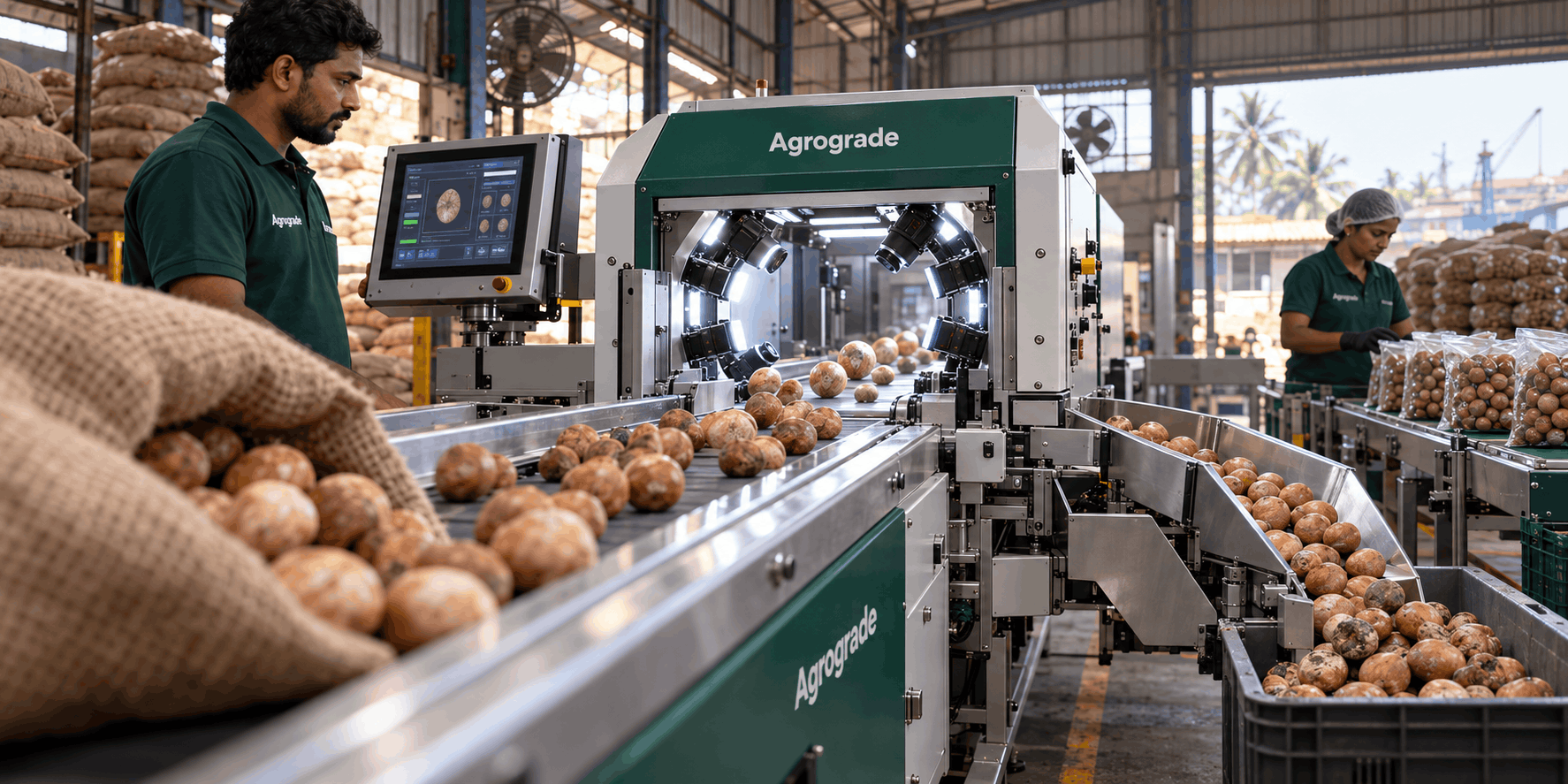
Arecanut sorting has traditionally depended heavily on trained workers visually inspecting large volumes of produce. Agrograde is trying to turn that judgement into an automated process. The Indian agritech startup has deployed an AI-powered optical sorting system specifically developed for arecanut, with its first commercial installation at Vikas Traders in Mangalore, Karnataka.
The machine can process approximately one tonne of arecanut per hour, allowing the facility to handle close to eight tonnes a day. Rather than relying mainly on colour differences, the system uses computer vision to examine individual nuts for visible external defects before automatically directing accepted and rejected produce into different streams.
That distinction matters because conventional colour sorters can miss defects that do not appear as simple colour variations. Agrograde’s patent-pending Vector architecture is designed to capture greater surface coverage despite differences in the size and shape of individual nuts. Each arecanut is photographed 10–12 times, with proprietary AI models analysing those images within milliseconds.
Getting there required adaptation to the crop rather than simply applying an existing sorting machine. Agrograde says development took almost five months and three product iterations.
The system was tested alongside Vikas Traders under real warehouse conditions including dust, humidity and foreign material. Its sorting accuracy began at about 75% and improved to roughly 89% after the AI models were updated using operating data.
Before automation, Vikas Traders said one worker could sort roughly two bags a day, while a team of about 15 handled 40–45 bags. The new machine provides more predictable throughput while also producing a quality summary for each lot, including size distribution, defect information and packed-nut counts.
The arecanut project also expands Agrograde’s broader post-harvest automation business. The startup already builds computer-vision and robotics systems for crops including onions, potatoes and apples, and recently deployed its 150th machine across 15 Indian states. The bigger shift is from using AI to analyse agriculture to putting it directly on the processing floor.
Filed by
Startup Unplugged