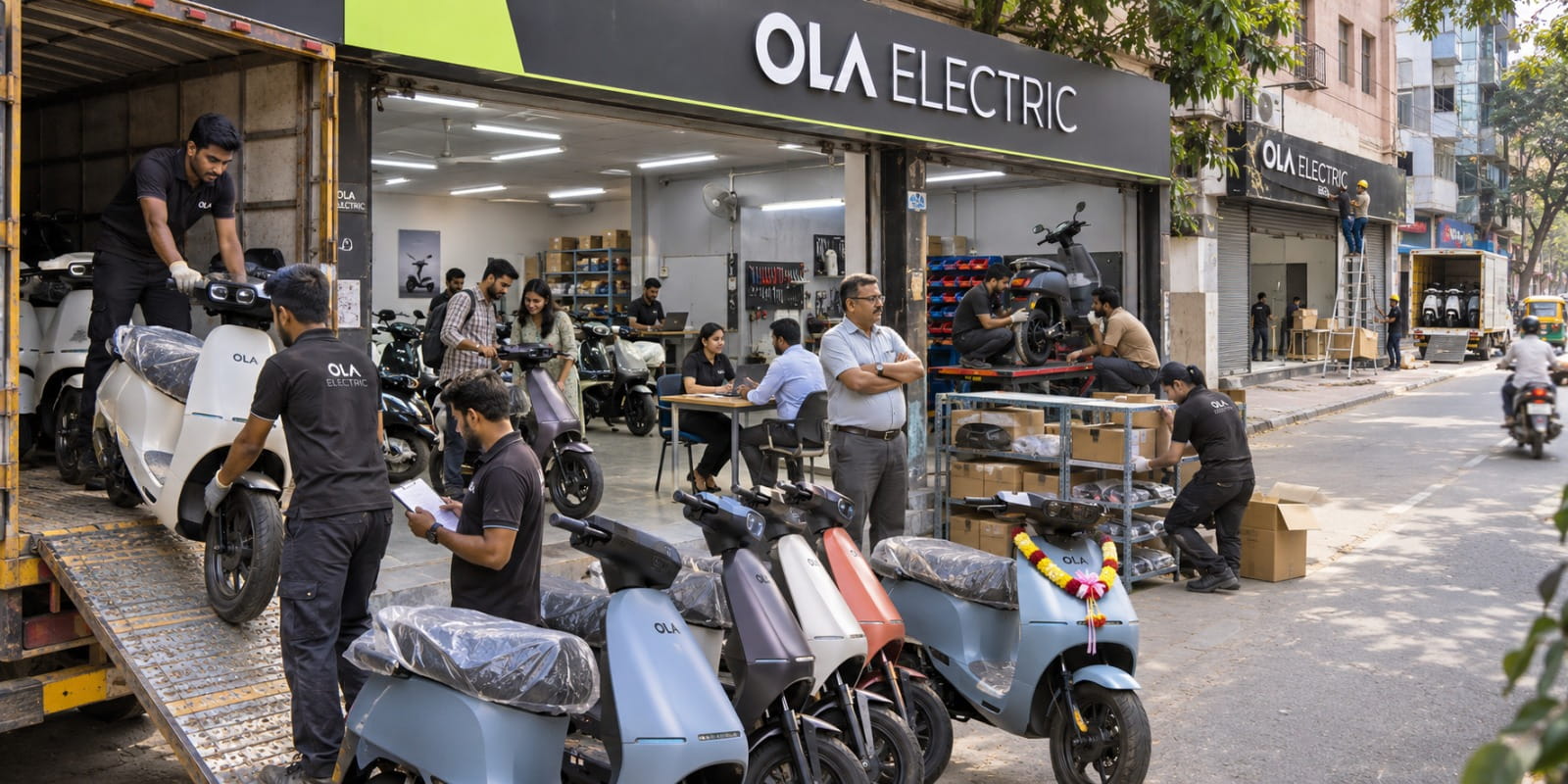
Ola Electric entered the scooter market by rejecting one of the oldest conventions in Indian automobiles: the dealer. Five years later, the company is reversing that decision. Ola stopped taking orders at its company-owned showrooms on November 1, 2026, with most expected to close by December as the EV maker shifts to a dealer-led sales and service model.
The first partner stores opened in September, and by November 8 Ola said 255 dealers were operating 319 sales outlets. It is targeting about 450 outlets by December and 700 by March 2027.
The change is partly about economics. Under the direct model, Ola funded its stores, inventory and associated working capital itself. Under the new structure, dealers purchase vehicles when\ ordering them and carry inventory locally. Ola expects closing company-operated locations to reduce operating expenses by another ₹50 crore, although dealer commissions will put somec pressure on gross margins.
The reset arrives after a difficult period for the company. Ola’s automotive revenue fell from ₹826 crore in Q1 FY26 to ₹264 crore by Q4 FY26 before recovering to ₹455 crore in Q1 FY27. Q2 FY27 revenue was about ₹420 crore, with 34,667 vehicle deliveries.
Ola’s earlier retail and service operation also faced customer complaints and regulatory scrutiny. YourStory notes that more than 10,000 complaints reached the National Consumer Helpline between September 2023 and August 2024, while some company-owned stores later faced questions around trade certificates. Ola’s latest shareholder communication does not explicitly say those issues caused the dealer transition, so the connection should not be treated as established fact.
Early wholesale orders through dealers have accelerated, rising from 3,955 vehicles in September to 13,505 in October. But wholesale dispatches are not the same as customer registrations, and Ola itself acknowledged slower registrations during October.
The real test is therefore not how quickly Ola can appoint dealers. It is whether local operators can sell, service and support customers more effectively — while allowing Ola to carry less retail infrastructure itself.
Filed by
Startup Unplugged