Getting a propulsion system to fire in space proves that the underlying technology works. Turning that system into something satellite and launch-vehicle customers can repeatedly deploy is a much longer engineering journey. Manastu Space has secured ₹116 crore in government financial support to make that transition.
The Technology Development Board under the Department of Science and Technology has signed an agreement with the Navi Mumbai spacetech startup under the government’s Research Development and Innovation Fund. Importantly, the support is structured as optionally convertible debt, not a conventional grant. The overall project is valued at ₹277.63 crore.
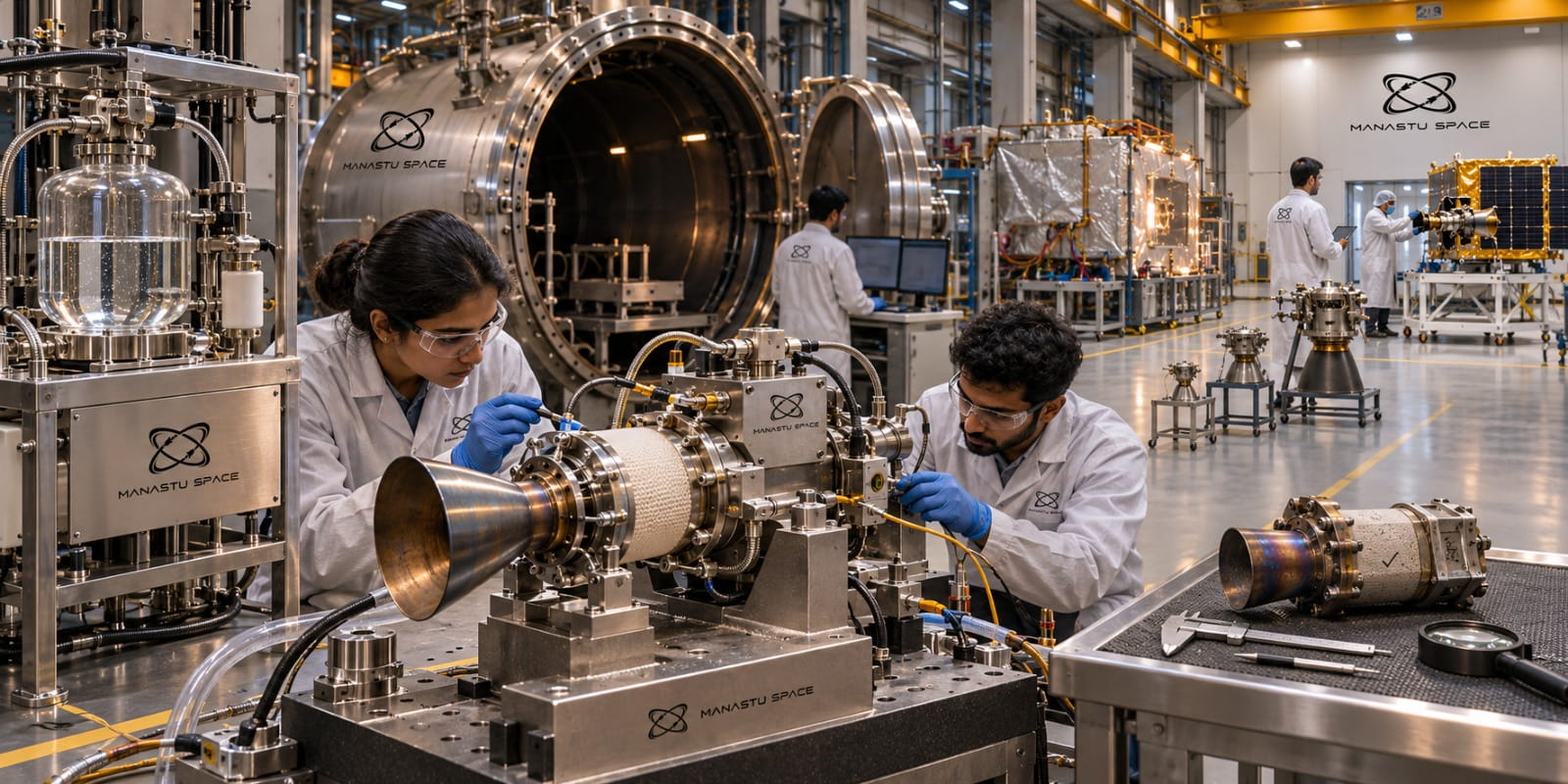
Founded in 2017 by IIT Bombay alumni Tushar Jadhav and Ashtesh Kumar, Manastu is developing propulsion systems using a hydrogen peroxide-based green propellant with additives. Its architecture includes engines, propellant-feed systems and an ultra-high- temperature ceramic catalyst intended to replace some of the operational complexity associated with hazardous conventional propellants.
The programme spans propulsion systems from 5 millinewtons to 300 newtons of thrust, giving Manastu a potential pathway from small-satellite manoeuvring systems to significantly higher-thrust applications. The government-backed project is specifically intended to take the technology from Technology Readiness Level 6 to TRL 9 through engineering, system integration, testing and validation.
Manastu is not starting from a laboratory-only prototype. Its Vyom 2U green propulsion system was flight-tested aboard ISRO’s POEM-4 platform, and the company says it achieved more than 700 seconds of cumulative in-space firing. It has also delivered its I-Booster system to DRDO.
The ₹116 crore commitment therefore funds the less glamorous but critical stage of deeptech: proving reliability repeatedly, integrating complete systems and preparing them for operational deployment.
If Manastu succeeds, the larger outcome is not simply a “greener” satellite engine. It is an indigenous propulsion stack capable of replacing a strategically important technology that satellite makers have historically had to source from a limited global supplier base.
Filed by
Startup Unplugged