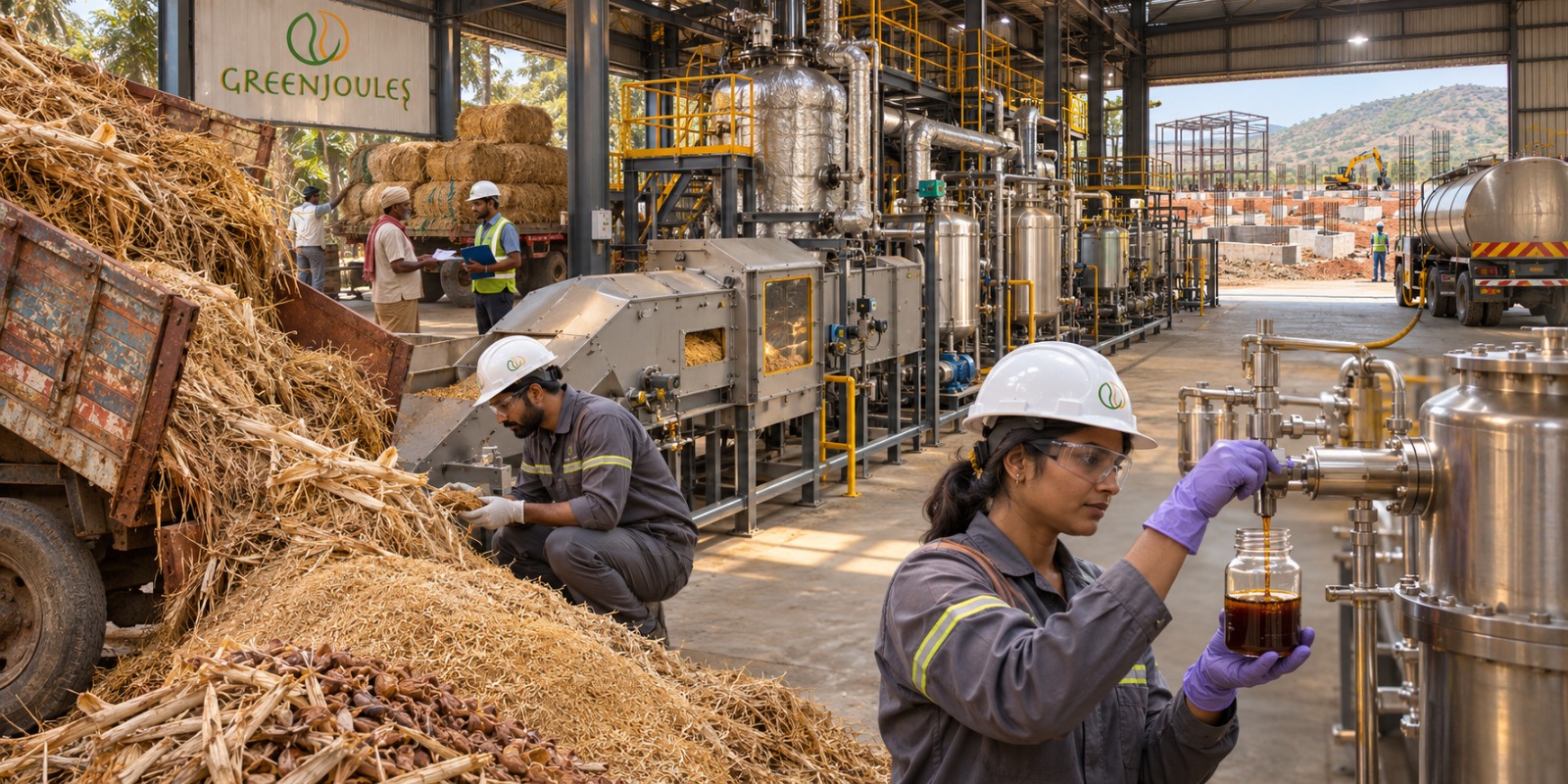
India generates huge volumes of agricultural residue every year while continuing to import most of the crude oil it consumes. Pune-based Greenjoules is trying to connect those two problems by turning crop waste into a feedstock for renewable fuels.
The company has raised ₹150 crore in Series B funding, co-led by Amazon’s Smbhav Venture Fund and Climate Pledge Fund. Rainmatter, Zerodha’s investment arm, and Singularity’s Strategic Autonomy Fund also participated, while existing investor Blue Ashva Capital remains Greenjoules’ largest shareholder.
Separately, Greenjoules has secured a ₹100 crore loan from the Technology Development Board, taking the total financing available for expansion to ₹250 crore. The capital will support a new facility at Khed City near Pune designed to produce 200,000 litres of biocrude per day from agricultural waste. Development is expected to begin in phases from 2027.
Founded in 2018, Greenjoules uses its proprietary Integrated Catalytic Thermocracking process to convert agricultural and agro-industrial residues such as paddy straw, husk, sugarcane bagasse and nut shells into biocrude. That intermediate fuel can then be refined into renewable diesel and bio-naphtha.
The company already operates a 15,000-litre-per-day plant at Chakan, which it plans to double to 30,000 litres per day by the end of January. Greenjoules has said its broader ambition is to reach 500,000 litres of daily biocrude capacity by 2028, making the Khed facility the central piece of that scale-up. These remain future capacity targets rather than current production levels.
Unlike first-generation biofuels that can rely on edible crops or vegetable oils, Greenjoules’ approach is built around agricultural residue. The company also plans to extend its technology toward sustainable aviation fuel, green hydrogen and sustainable materials.
The larger bet is therefore not simply cleaner diesel. It is whether an abundant, low-value farm residue can become reliable industrial feedstock — at enough scale to matter to transport, farmers and India’s dependence on imported fossil fuel.
Filed by
Startup Unplugged