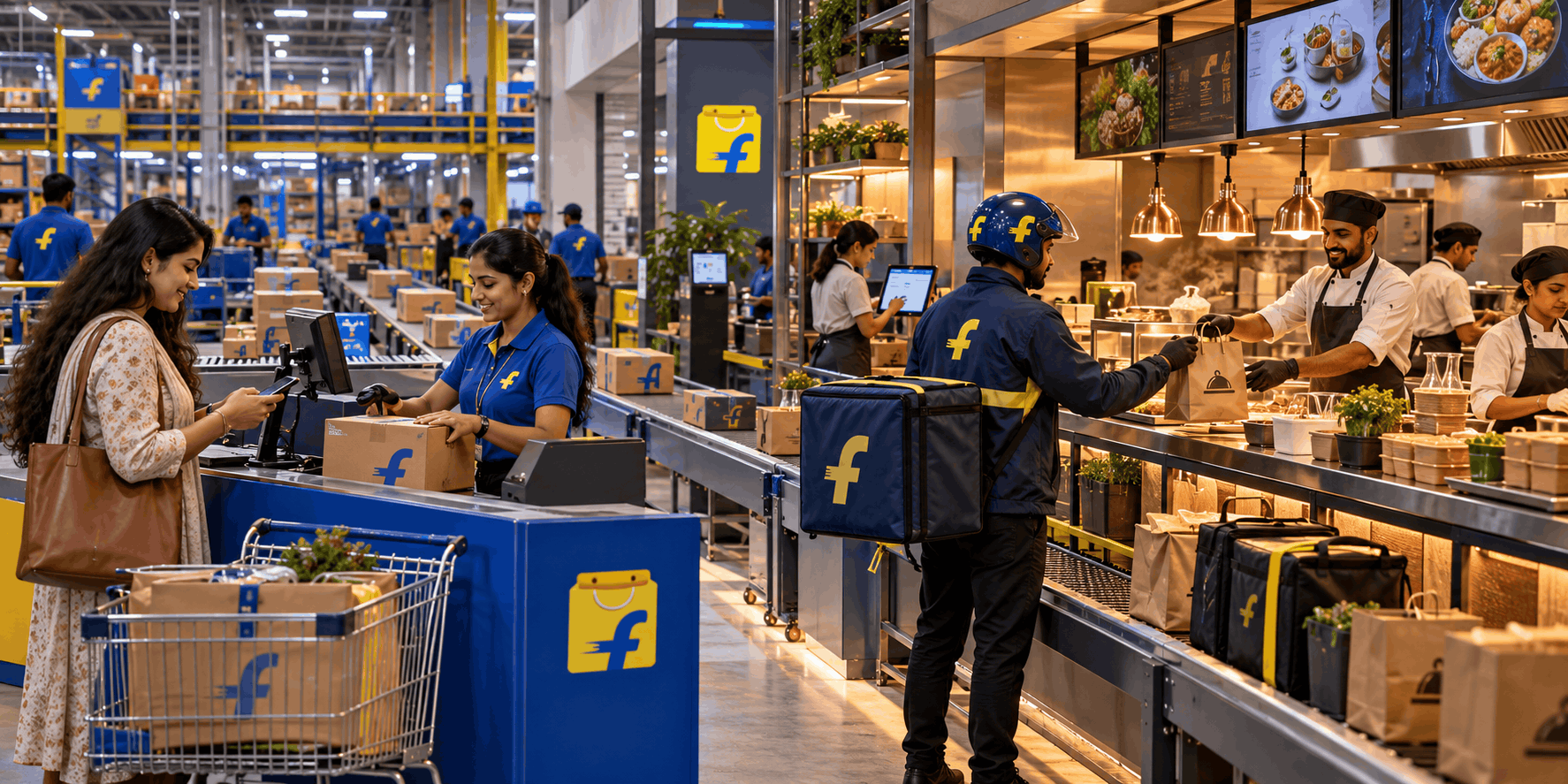
Flipkart is reportedly preparing to take its food delivery experiment public by the end of October, turning what began as an employee pilot into a broader challenge to India’s dominant food delivery platforms.
The Walmart-owned ecommerce company has expanded internal testing of **Eat-in by Minutes** to more than 8,000 employees in Bengaluru. According to people familiar with the rollout, Flipkart has told restaurant partners it is targeting a public launch by October-end, followed by expansion to five or six cities by the end of 2026. Flipkart had not formally confirmed the timeline at the time of reporting.
The service currently appears as a separate section inside Flipkart’s main shopping app. Rather than relying entirely on its quick-commerce fleet, Flipkart has also deployed a dedicated delivery network through Ekart for food orders. On the restaurant side, it is using a mix of ONDC-listed partners and direct onboarding.
One of Flipkart’s clearest differentiators could be restaurant economics. National Restaurant Association of India president Sagar Daryani said the company has discussed a base commission of around 10%, significantly below the 20%-25% restaurants typically pay established aggregators. That does not necessarily mean total platform costs will be lower once advertising, discounts and promotions are included, but it gives Flipkart a strong entry point for restaurant conversations.
The bigger advantage may be distribution. Flipkart already has hundreds of millions of registered users and an ecosystem spanning ecommerce, quick commerce, travel and rewards.
That means food delivery does not need to build consumer awareness from zero. Earlier reporting also indicated Flipkart could use its existing SuperCoins base and logistics infrastructure to cross-sell food orders.
The timing also matters. Zomato and Swiggy remain the market leaders, but new entrants including Rapido’s Ownly, Swish Go and Curefoods’ MegaBite are attacking restaurant commissions and consumer fees from different angles. For Flipkart, food delivery is not just another category. It is another attempt to turn one high- frequency consumer app into a broader commerce destination — and meals may be its most habit-forming test yet.
Filed by
Startup Unplugged