India’s artificial intelligence startup ecosystem is moving beyond the race to build general-purpose foundation models, with a new group of companies focusing on data, infrastructure and specialised applications.
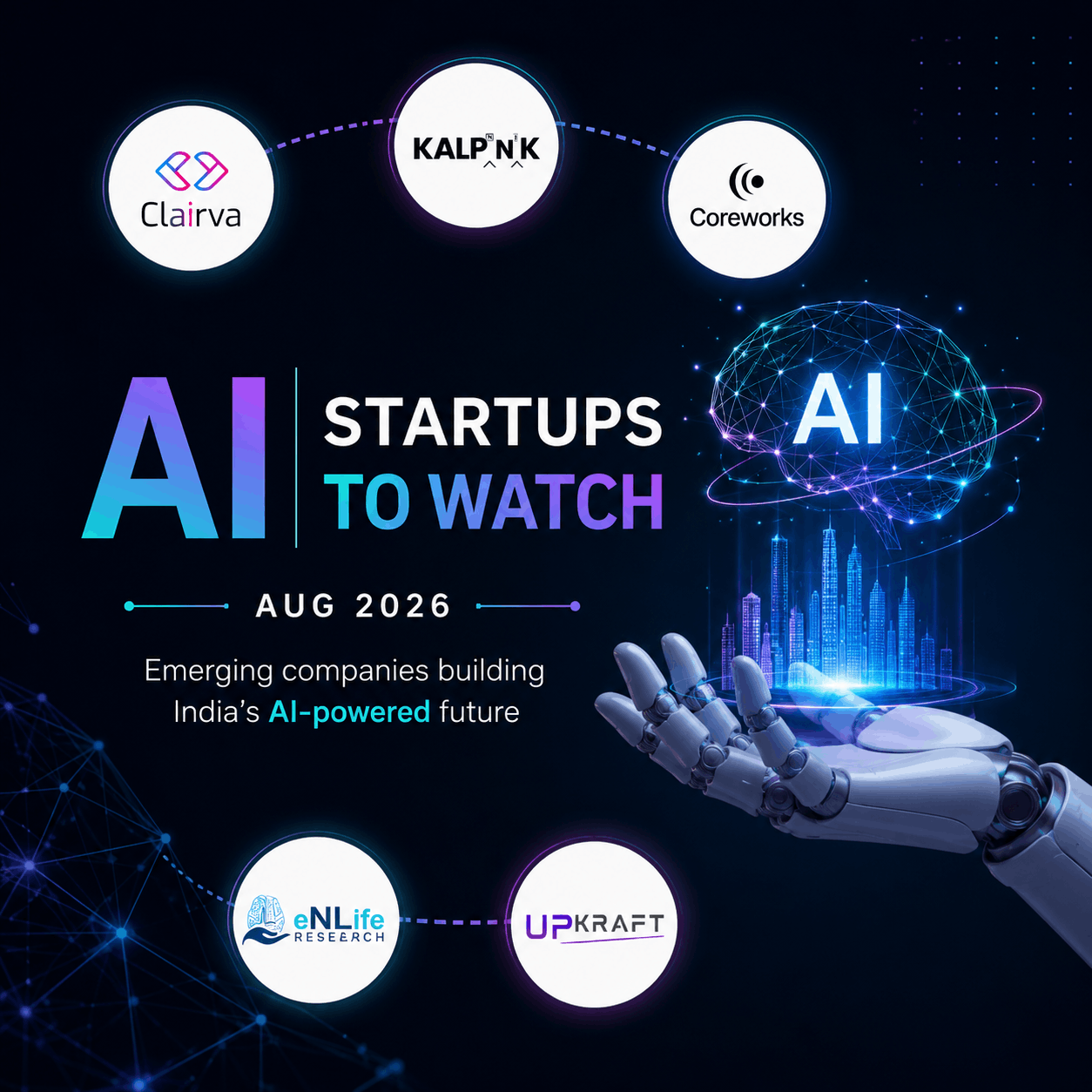
Inc42’s latest AI Startups To Watch list identifies five emerging Indian ventures working across physical-world data, cinematic AI, enterprise productivity, healthcare and education. The companies reflect a broader shift towards building AI systems around specific commercial and industry problems.
The change comes as India seeks to strengthen its position in artificial intelligence. The government’s IndiaAI Mission has an approved outlay of about ₹10,371.92 crore over five years and includes efforts covering compute infrastructure, datasets, indigenous AI capabilities and startup support.
The government has also selected proposals for developing indigenous foundational AI models under the IndiaAI Mission. The initiative is designed to support models trained on Indian datasets and address requirements across languages and sectors.
Inc42 said Indian AI startups raised $676 million during the first six months of 2026, almost four times the amount raised during the corresponding period of the previous year. The funding indicates growing investor interest, although capital alone does not determine whether emerging AI businesses can achieve commercial scale.
The startups highlighted by Inc42 are focused on different parts of the AI ecosystem. One area is physical-world data, where companies seek to create datasets that can help AI systems understand real-world environments and actions.
Another emerging area is cinematic AI, where generative technology is being applied to video and content production. Such companies are attempting to reduce the time and resources required to create visual content while developing tools aimed at professional users.
Enterprise productivity is another focus. AI companies targeting businesses are building systems that can automate repetitive work, assist employees and adapt to company-specific workflows and data.
Healthcare represents a different challenge because AI systems must work with specialised scientific and clinical information. Deeptech healthcare startups are therefore combining artificial intelligence with domain-specific research rather than relying solely on general-purpose models.
Education is also becoming a testing ground for AI applications in India. Startups in the sector are developing systems designed around learning, content and student support, with the potential to address India's large and diverse education market.
The broader trend is important because India's AI opportunity may not depend on producing the world's largest foundation model. Companies can instead build advantages through proprietary datasets, specialised domain knowledge, local-language capabilities and applications designed around Indian market conditions.
India's linguistic diversity is one example of where local capabilities can matter. The IndiaAI Mission has identified multilingual AI and datasets as important components of the country's broader artificial intelligence strategy.
For startups, building these capabilities can also create a stronger barrier to competition than simply adding an AI feature to an existing product. A company with specialised data, domain expertise or deep integration into customer workflows may be harder to replicate than one relying entirely on publicly available AI models.
The funding environment is also changing. As more capital enters India's AI sector, investors are increasingly looking at how companies turn technical capabilities into products with identifiable customers and sustainable economics.
The five startups featured by Inc42 therefore represent a wider transition in India's AI market. Instead of asking only who will build the next major AI model, the ecosystem is increasingly focused on who can build useful businesses around artificial intelligence.
The next phase will depend on whether these companies can convert technical innovation into commercial adoption. Their progress will also provide a clearer picture of where India's AI ecosystem can develop distinctive strengths as competition intensifies globally
Filed by
Startup Unplugged