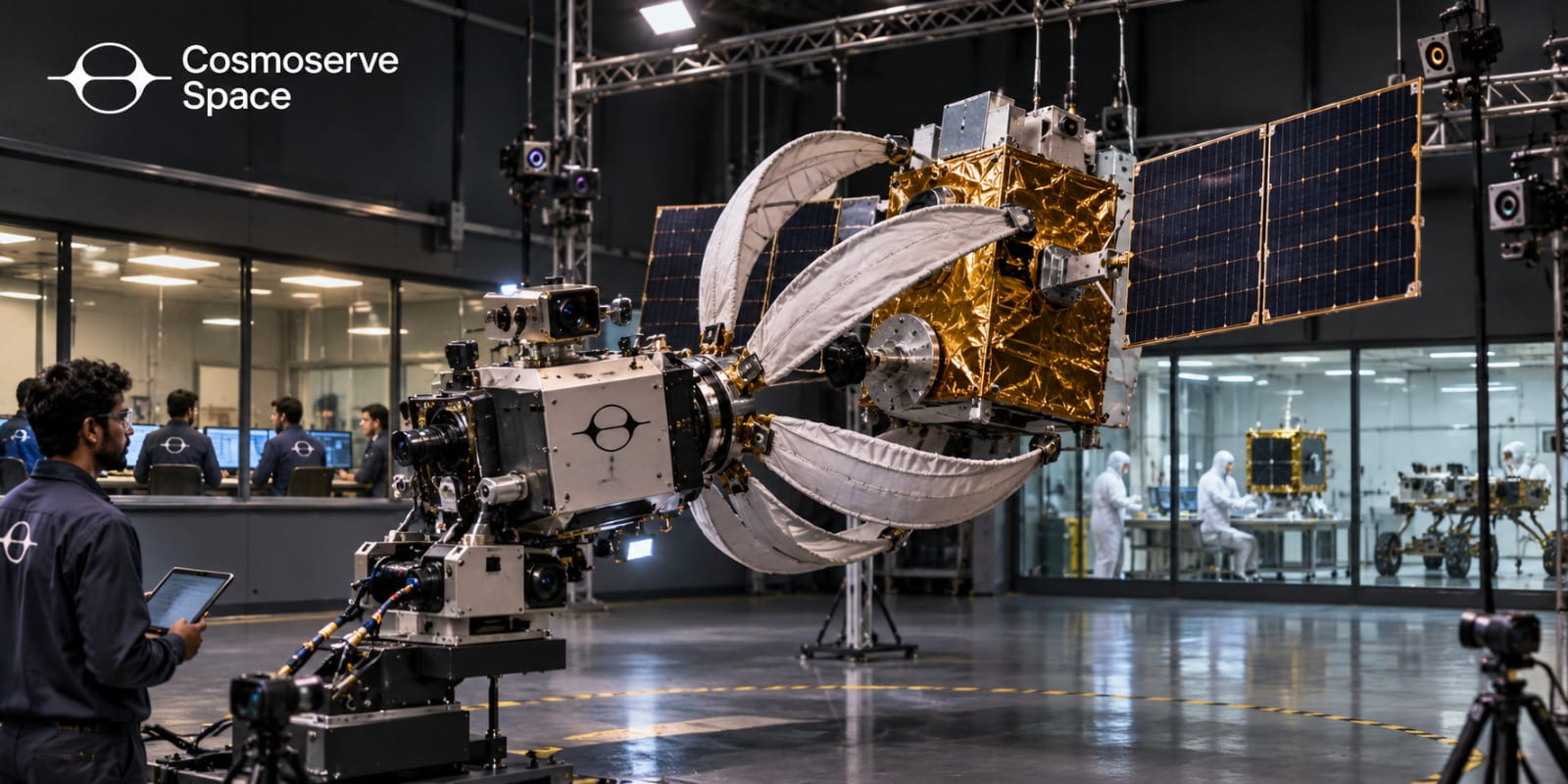
A satellite reaching the end of its life does not simply disappear. It can remain in orbit for years, adding to a growing debris problem that threatens active spacecraft. Hyderabad-based Cosmoserve Space has raised $6 million in seed funding to develop robotic systems designed to capture, repair, refuel or remove satellites already in orbit.
The round was led by Japan-based Rebright Partners, with participation from Aranya Holdings, Naandi Ventures and existing investors AUM Ventures and Shakti VC. It takes Cosmoserve’s total funding to more than $9 million. The capital will support technology demonstrations, two upcoming missions and the development of its newly inaugurated Hyderabad facility, Base 1.
Spread across roughly 14,800 sq ft, Base 1 brings together an orbital rendezvous and capture lab, space robotics laboratory, microgravity simulation infrastructure, ISO Class 8 satellite- integration clean room and mission-control centre. Government and company statements describe it as India’s first private integrated facility of its kind and the sixth globally with space- vision and microgravity-simulation capabilities.
Founded by Chiranjeevi Phanindra, Cosmoserve is developing a two-spacecraft servicing architecture. A larger orbital service station would carry fuel, equipment and spare parts, while a smaller autonomous service vehicle would travel between satellites to inspect, dock, repair or remove them. The company says the model could eventually allow two spacecraft to service upto 100 satellites and potentially reduce servicing costs from around $10 million to below $1million per satellite. These remain company projections rather than commercially demonstrated economics.
Cosmoserve has already flown its Mission Embrace payload aboard Skyroot Aerospace’s Vikram-1 in July 2026. Its roadmap now includes microgravity testing of robotic capture systems, another technology-demonstration mission and a full-scale debris-capture demonstration in 2027, followed by targeted commercial operations in 2028.
The larger opportunity is not simply cleaning up orbit. If satellites can be repaired, refuelled and
safely removed instead of abandoned, space infrastructure could start operating more like
equipment on Earth — maintained throughout its useful life rather than discarded when
something goes wrong.
Filed by
Startup Unplugged