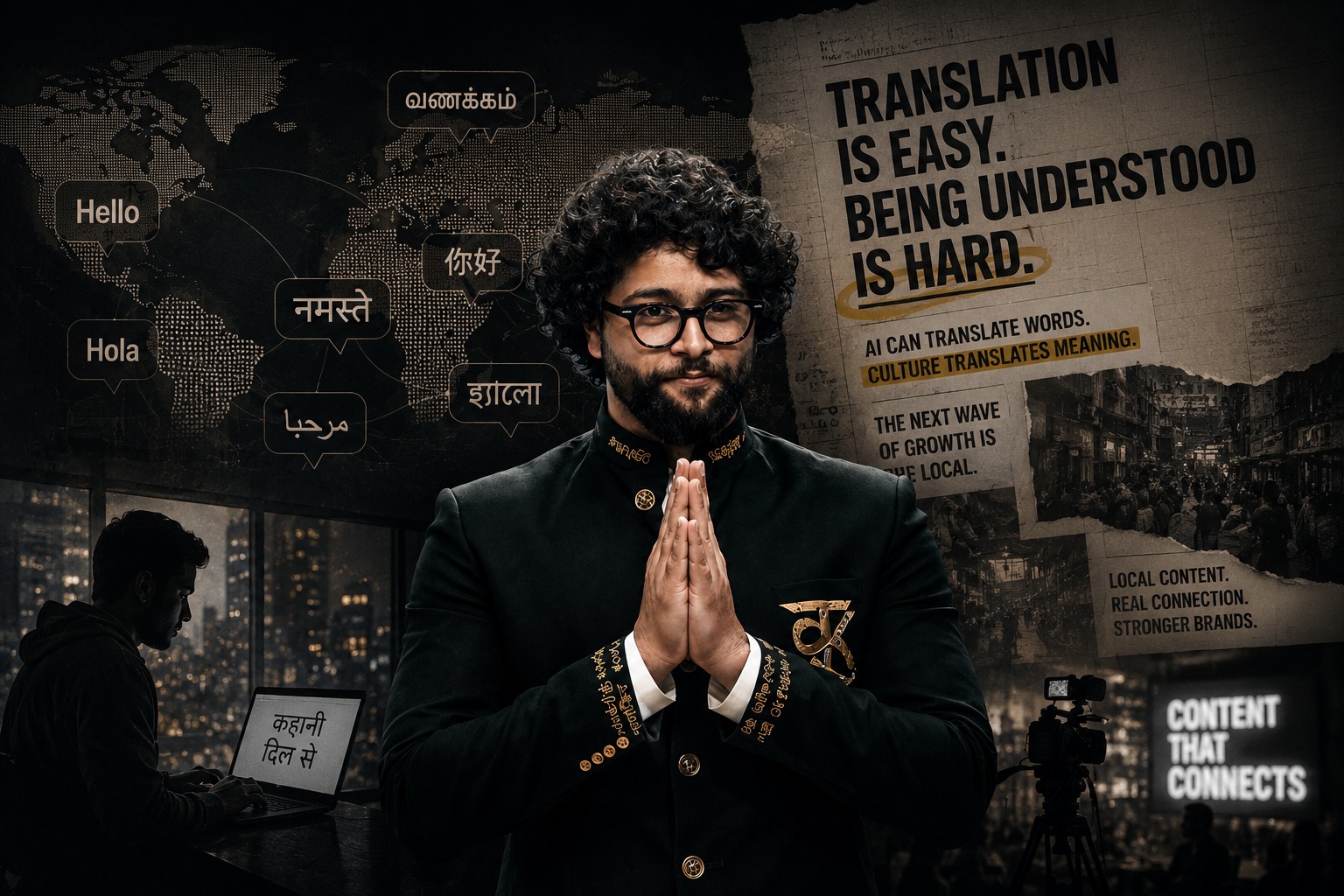
A few years ago, translating content into multiple languages was expensive, slow, and often reserved for large corporations. Today, anyone can translate a paragraph into dozens of languages within seconds. AI tools have made language conversion faster and more accessible than ever before. On the surface, it feels like one of communication's biggest challenges has finally been solved.
But language was never the real challenge.
Understanding was.
Most people have experienced this without realizing it. You've probably come across an advertisement, video, or social media post that was technically translated correctly but still felt unnatural. The words made sense. The grammar was accurate. Yet something felt missing. It sounded as though the message had been imported rather than created for the audience reading it.
The words arrived. The meaning didn't.
As businesses expand across geographies, this gap between translation and understanding is becoming increasingly important. For years, many brands built their communication strategies around English-speaking consumers. That approach worked when internet adoption was concentrated in large cities and among relatively similar audiences. But today's internet looks very different.
The next wave of digital growth is coming from users who consume content in regional languages, follow local creators, and connect more deeply with brands that feel culturally familiar. These consumers are not simply looking for information in their preferred language. They are looking for communication that reflects their context, experiences, and way of thinking.
This shift has quietly created opportunities for companies operating in an often-overlooked category: localization.
One such company is Kalakrit. Founded by Sehaj Kohli, Kalakrit helps businesses adapt their content, communication, and experiences for different languages and cultural contexts. The company works across translation, localization, dubbing, voiceovers, and regional content adaptation. At first glance, that may sound like a straightforward language service. In reality, it reflects a much larger business trend.
The most successful brands today are discovering that entering a new market requires more than translating a message. It requires understanding how that audience communicates, what they relate to, and how they interpret information.
A marketing campaign that resonates with consumers in Delhi may not create the same response in Chennai. A phrase that feels natural in Hindi might sound awkward when directly translated into another language. Humour, emotions, references, and even trust often work differently across regions. The challenge is not finding the right words. The challenge is creating the right connection.
This is why localization has become far more strategic than it was a decade ago. Businesses are no longer asking how to translate content. They are asking how to make content feel local.
What's particularly interesting is that this trend is accelerating at the exact moment AI has made translation easier than ever before. Technology has solved many of the mechanical aspects of language, but it has also highlighted the importance of everything that exists beyond words. AI can explain what a sentence means. It often struggles to explain why that sentence matters to a particular audience.
In many ways, the rise of localization companies like Kalakrit reflects a broader shift in how businesses think about growth. For years, scale was achieved through standardization. The goal was to create one message that could reach everyone. Increasingly, companies are realizing that growth may depend on doing the opposite. The future may belong to brands that can make millions of people feel like they are being spoken to individually.
This is visible across industries. Streaming platforms are investing heavily in regional content. Influencers are building massive communities in local languages. Consumer brands are creating market-specific campaigns instead of relying on national messaging. The internet may have connected the world, but it has also made local identity more valuable than ever.
Perhaps that's because people don't just want information. They want familiarity. They want to feel understood.
And understanding has always been far more complex than translation.
Startup Unplugged Perspective
The most interesting businesses often emerge when technology solves one problem and reveals another. AI has made translation faster, cheaper, and more accessible. But in doing so, it has exposed a deeper challenge: cultural understanding.
Kalakrit operates at the intersection of that challenge. Its business is built on a simple but powerful idea. Reaching people and connecting with people are not the same thing. As companies continue expanding into new markets, the ability to communicate across cultures may become just as important as the ability to build great products.
Because in business, being understood is often more valuable than simply being heard.
If AI can translate almost any language today, will culture become the last true barrier to communication?
Share your take
What is your perspective on this article?
Written by
Team Startup Unplugged
_11.png)

.png)