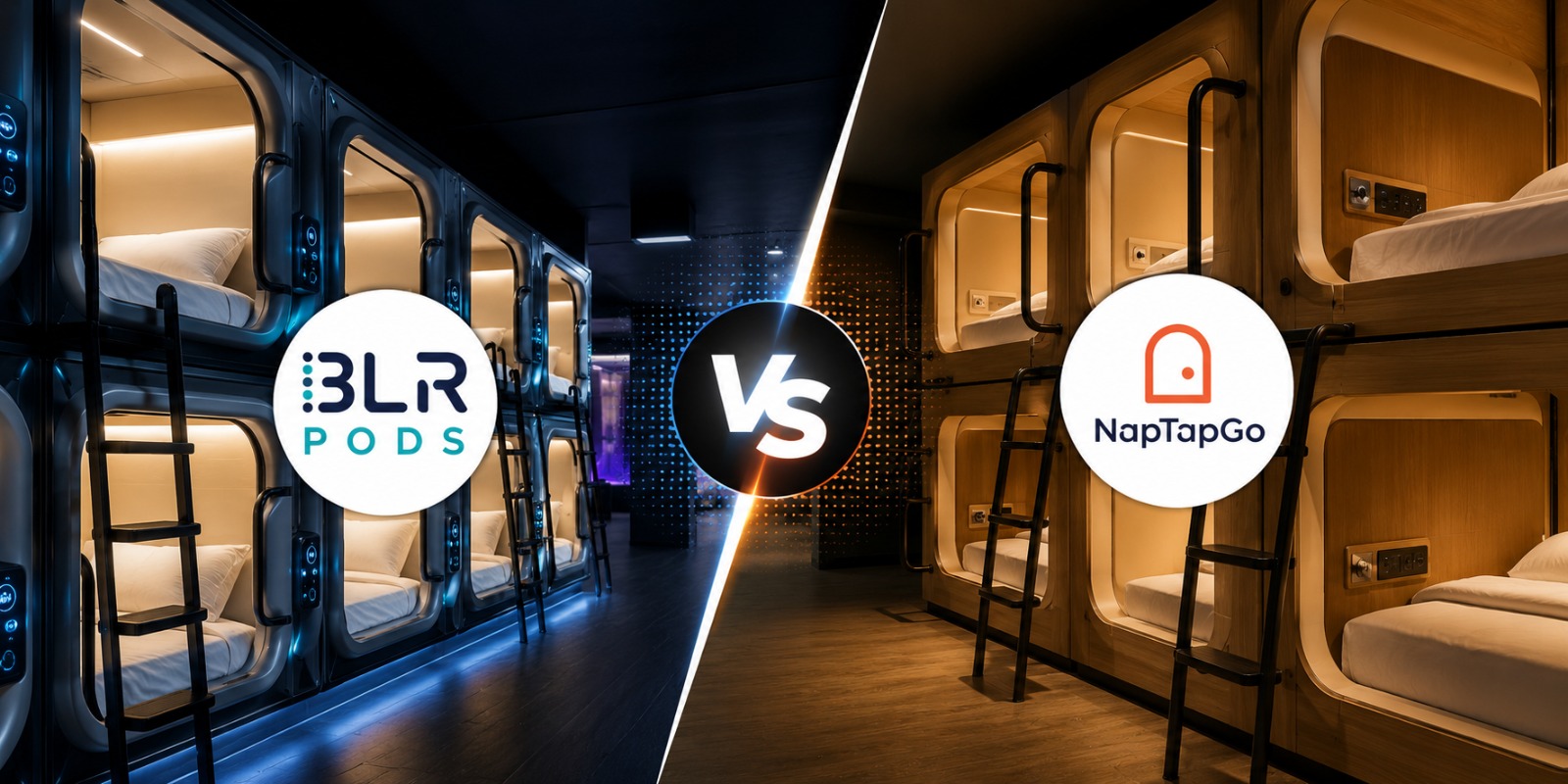
The Business Model: Japan's Pod Culture, Localised for India
Both startups are riding the same wave bringing Japan's capsule hotel concept to India's urban travellers, IT professionals, and transit passengers who need a clean, affordable place to rest for a few hours rather than a full night. The pitch to Indian consumers is simple: hourly, flexible stays at a fraction of the cost of a traditional hotel room.
BLR Pods operates out of Brookefield in Bengaluru, close to ITPL and Whitefield's tech corridor, positioning itself squarely toward IT employees, business travellers, and digital nomads. NapTapGo has taken a different geographic bet, with pods live in Noida, Amritsar, and Katra locations that combine a business hub, a religious tourism circuit, and a pilgrimage town.
Both companies pitched on the same episode of Shark Tank India Season 5, in a "match-off" format where the sharks compared the two directly. BLR Pods, founded by Nagakarthik Doddamani and Rajesh Badami, sought Rs 90 lakh for 1.5% equity. NapTapGo, founded by Nitin Malhotra and Himanshu Shukla, asked for Rs 2 crore for 2.5% equity. Neither secured an investment on the show.
What BLR Pods Is Doing Well
Clear niche targeting. By anchoring itself in Brookefield, right next to Bengaluru's IT corridor, BLR Pods has built a product around a specific, recurring customer: tech employees needing a nap between shifts, a workspace for a few hours, or a cheap overnight stay near the office. This is a smarter wedge than trying to serve all travellers everywhere.
Transparent, aggressive pricing. Rates starting at Rs 299 for three hours, with clear hourly slabs up to 24 hours, make booking frictionless and comparison against traditional hotels a no-brainer.
Low-friction booking. WhatsApp-first booking, sub-60-second check-in, and 24/7 access are genuinely useful conveniences for the transit and IT-shift crowd that forms its core audience.
Franchise ambitions. BLR Pods is already pitching itself as a franchise opportunity, positioning the pod hotel format as a proven, replicable business rather than a single-location experiment.
Where BLR Pods Is Falling Short
Single-location dependency. As of now, the brand's entire operating footprint appears concentrated in one Bengaluru micro-market. That's a risk: any disruption to that one property (lease issues, local competition, area saturation) directly threatens the whole business.
SEO-stuffed, cluttered website. The homepage is packed with keyword-heavy meta descriptions and repetitive landing-page copy clearly built for search rankings rather than user experience. This can hurt credibility with a discerning, tech-savvy target audience that will notice when a site feels more like an ad than a product.
Thin proof of scale. Claims like "15k+ happy guests" and "600+ Google reviews" are reasonable but unverified on-site, and the franchise pitch (starting at Rs 99 lakh) is asking potential partners to buy into a brand with a fairly short public track record.
No visible tech or app layer. Relying on WhatsApp for booking is convenient short-term, but it doesn't scale well operationally once the brand tries to run multiple properties with real-time inventory across cities.
What NapTapGo Is Doing Well
Multi-city footprint. NapTapGo already operates across Noida, Amritsar, and Katra three very different kinds of demand (business travel, general urban transit, and pilgrimage tourism). That diversification is a meaningfully stronger base than a single-location model.
Built-in tech infrastructure. The presence of a proper web platform with login, a blog, and structured franchise and FAQ pages suggests NapTapGo has invested more in a scalable digital backbone rather than depending purely on messaging apps.
Clear value proposition communication. The site's "why choose us" section is direct about the pillars that matter: affordability, safety, flexible check-in, and hourly stays communicated with less SEO noise and more actual user-facing clarity than its rival.
Smart location logic. Katra, in particular, is a clever choice, a pilgrimage town with huge transient footfall and a persistent need for short, affordable rest stays, an underserved niche compared to saturated metro markets.
Where NapTapGo Is Falling Short
Thin content depth. The homepage feels sparse compared to the scale of ambition, limited pricing transparency (no visible hourly rate card, unlike BLR Pods), and only a single testimonial displayed live on the site.
Weaker brand energy. Where BLR Pods leans hard into an energetic, youth-oriented tone with video and reels, NapTapGo's presentation feels more generic and corporate, which may undercut appeal with the same young, digital-first crowd both companies are chasing.
Ambiguous unit economics story. Asking for a larger cheque (Rs 2 crore) against similar or even earlier-stage traction than BLR Pods raised questions among the sharks about valuation and cash burn, a signal that its capital efficiency story wasn't fully convincing.
Location strategy risk. Betting on smaller cities like Amritsar and Katra brings lower real estate costs but also smaller, more seasonal demand pools compared to a dense tech hub like Bengaluru's IT corridor.
How Each Startup Can Improve
For BLR Pods:
- Expand beyond Brookfield to at least 2–3 more Bengaluru micro-markets before pushing franchise sales, to prove the model is repeatable, not a one-off
- Invest in a proper booking platform/app rather than relying solely on WhatsApp, especially before scaling via franchise partners
- Clean up the website's SEO-heavy copy into something that reads like a premium hospitality brand, not a keyword farm
- Publish verifiable occupancy and guest data to build franchise investor confidence
For NapTapGo:
- Add transparent, itemised pricing on the homepage hidden pricing creates friction and mistrust for a value-led brand
- Build a stronger visual and social media identity; more reels, real guest stories, and personality in the brand voice
- Show clearer city-wise traction numbers to justify the higher ask size in future fundraising conversations
- Double down on the Katra/pilgrimage-circuit niche, where competition is thinner and demand is more predictable
Who's Better, and Why
There's no single clean winner; the two startups are optimising for different things.
On brand experience and niche focus, BLR Pods edges ahead. It has a sharper identity, an aggressive and transparent pricing table, and a tone that speaks directly to its core Bengaluru tech-worker audience. If the goal is depth in one high-density market before expanding, this is the stronger near-term consumer play.
On geographic diversification and infrastructure, NapTapGo looks better built for scale. Operating across three very different city types, with a proper tech platform behind it, suggests a more deliberate expansion strategy rather than a single hometown bet.
If forced to pick one as the better long-term business today, NapTapGo has a structural edge simply because multi-city presence de-risks the model in a way BLR Pods hasn't yet demonstrated. However, BLR Pods has the stronger brand and pricing execution in its home market, and could close the gap quickly if it expands within Bengaluru and cleans up its digital presence.
Both companies were right to walk away from Shark Tank without a deal rather than take unfavourable terms; the fact that both are still visibly operating, marketing, and pursuing franchise growth well after their episode aired suggests real underlying demand for capsule hotels in India. The real test for both will be whether they can convert single-city or single-format traction into a nationally recognisable, profitable chain before a larger, better-funded player enters the space.
Share your take
What is your perspective on this article?
Written by
Team Startup Unplugged
_11.png)

.png)